
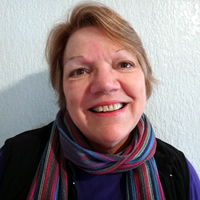
 Message from the Executive Director, Barbara Champion
As we all emerge from winter hibernation it has been a very busy time in the play world! Since our last edition I have had some wonderful conversations with our members regarding our Discussion Paper from around the country, and their enthusiasm to have Play Australia effectively operating nationally is overwhelming.
Feedback from members is vital and thanks to those of you who directly responded. Here are some of the key discussion points you raised as important to support the development of the national organisation:
- supporting the advocacy role of the organisation (State and Federal levels)
- roles to include advocacy on issues that impact on children’s play, building infrastructure to support play, and development of the play work sector
- partnership opportunities with like organisations
- suggestions for programs and services to further promote play and information sharing
- the stronger voice of a national organisation.
Please remain involved in this process! As a membership based organisation we need your participation and involvement. A copy of the FINAL REPORT can be found on the website.
 The next steps for Article 31
Article 31 General Comment set to launch! By Robyn Monro Miller, Executive Director of Network of Community Activities, and Vice President of the International Play Association.
Hopefully by now you have heard the great news that on February 1, 2013 the UN Committee on the Rights of the Child adopted General Comment #17 on article 31 of the Convention on the Rights of the Child (CRC). A summary of the General Comment has been compiled by the International Play Association and is available for downloading from the Play Australia website.
Article 31 covers the rights of all children to participate in play and recreation activities, have time for rest and leisure, and to participate in arts and culture. The General Comment (GC) explains in depth the provisions of the article with a goal of enhancing the States parties’ understanding of and adherence to their responsibilities as contained in the article.
Since 2008 IPA has led an international group of co-signatories to the request for a GC and has been closely involved in its development. IPA is extremely proud to have been a part of this effort. IPA world will be hosting the international launch of the UN General Comment on article 31. This landmark event is being organised by the IPA (supported by the Bernard van Leer Foundation) on 30th September 2013.
The launch will take place in central Geneva, the symbolic home of the United Nations, with an address from the UN Committee on the Rights of the Child.
Robyn Monro Miller will be our guest speaker at the Play Australia AGM Thursday 31st October 2013.
Launch key topics to be explored:
- maintaining and raising awareness of article 31 within the UN Committee including new Committee members
- building use of the GC as a reference point in NGO and Government reports to the UN
- persuading policy makers and planners to use the GC as a reference point/guide in making decisions
Playground Standard
A new Playground Standard in Australia is set to be published in 2014. Currently a draft document is out for public comment and Play Australia has been in regular communication with our members about this very complicated and extraordinarily confusing piece of work. Comment is required by October 15 and we will do our best to ensure that all feedback is collated and provided to the Standards Committee. We thank Mary Jeavons of Jeavons Landscape Architecture and Andrew Reedy of Forpark Australia for their work in consulting with our members nationwide on the proposed changes. We will keep you posted on developments.
Schools must keep PLAYING
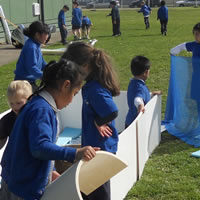
Dr Barbara Chancellor is a lecturer in the School of Education at RMIT University and recently completed a research study which investigates the play of children in Australian primary school playgrounds. Aspects of her research included issues associated with playground design, equipment and teacher supervision. However, her main focus was the children’s play.
Dr Chancellor’s teaching background is in both primary schools and early childhood settings and she is currently involved in promoting the importance of children’s play in a number of local and international forums.
Here are some excerpts and comments from Dr Chancellor about her research undertaken in 2011 and published this year in the International Journal of Play. It provides a compelling message to our governments that Australian schools must maintain the provision of outdoor play opportunities for children. For further information regarding Dr Chancellor’s research please go to our website.
Dr Chancellor conducted an online survey of government primary schools in June 2011 in Victoria. This study aimed to investigate how individual school policy is impacting on playgrounds in the areas of play space design, play equipment, rules and supervision of children during recess breaks.
Data analysed in light of international and local research findings about children’s play indicate that many schools are providing playgrounds with a wide range of play possibilities through provision of high quality, diverse play spaces incorpo- rating natural features. It also shows that playground rules reflect teacher attitudes and understandings about children’s play in the playground, demonstrating their belief in the need for surveillance and safety as paramount.
“Many schools are providing playgrounds with a wide range of play possibilities through provision of high quality, diverse play spaces incorporating natural features.”
The over-organised and over-protected lives of children and the large numbers living in urban environments with limited access to safe outdoor play mean that opportunities for free outdoor play diminish or vanish altogether for many children. For children without backyards or access to local parks, their only chance to play together outside is likely to be at recess breaks in school. Consequently, schools today have an increasingly important role in facilitating play opportunities.
Following the implementation of the Victorian Early Years Learning and Development Framework in 2011 for children from birth to eight years, teachers are now seeking ways of addressing learning through play. It is timely to remember the comments of Brian Sutton-Smith: ‘Even those who have announced recently that they are in favour of children’s rights to play usually wish to organise it in some way and not leave it to nature.’ (Sutton-Smith in Pellegrini, 1995, pp. 279–280).
Dr Chancellor explains that the latest 2011 research was about seeking the big picture of school playgrounds in Victoria, with a view to extending the study interstate and internationally.
“My aim of this most recent research was to disagree with the picture often painted in the media that is critical of schools and how they manage their playgrounds. I have felt strongly for a long time that many schools are doing great things but I needed some research to prove it. I found what I had been hoping for, and more, with lots of schools in Victoria providing inspiring playgrounds full of natural features,” says Dr Chancellor.
The next stage of this research is to conduct case studies of schools, currently in the early stages, and identify what makes parts of the school playground fun places to be in for children. This research will be a collaborative project between Dr Chancellor and Mr Brendon Hyndman, a published playground researcher from RMIT University.
The 2011 study is now being implemented internationally and Dr Chancellor now aims to gain a larger picture of school playgrounds. “We want to celebrate what is inspirational. School principals and teachers are doing amazing things in their playgrounds and their stories may be helpful to schools who are developing areas of their playgrounds,” Dr Chancellor said.
Dr Barbara Chancellor is a Play Australia Board Member
The new National Arboretum playground in Canberra
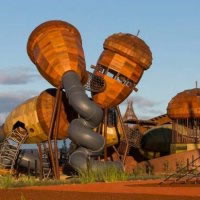
This unique playground is bringing interest and excitement to Canberra, and with very good reason. Features include climbing nets, cubbies that are a hub of acorns and discovery trails, all to the great delight of visiting children and their parents watching the smiles on their faces.
An interview with the playground designer Simone Bliss, a landscape designer with Taylor Cullity Lethlean, and Play Australia’s Barbara Champion, was featured on Radio National Bush Telegraph back in August. Here’s a snippet of how this playground is being discussed as setting a new benchmark for play spaces in Australia.
Simone Bliss describes where the idea for this design began,“There was a cork oak forest located there from 1917, I thought ‘let’s take that as a theme’ and imagined that the acorns that lay on the forest floor were catapulted up to another area of the site. Then we wanted to introduce another element of vegetation being the weird looking banksia cone. It was an area that would attract children and then they’d start to explore the broader arboretum and discover nature. Second to that we wanted to inject risk and challenge and imagination and spontaneity and make something we hadn’t seen anywhere else.”
Ms Bliss acknowledges a playground built in Canberra on a budget of $1.7 million, may not be feasible in smaller regional areas. Barbara Champion says playgrounds need to have some level of risk involved to be of real benefit to children.
“We’ve had a decade of focus on providing risk free activities for children and if you think about it, it’s a bit of nonsense. Yes they may be able to scrape their knee, or sprain their ankle if they fall off a monkey bar, but the benefit to the child, in being able to use a monkey bar, far outweighs the possibility of a small injury. The tragedy today is that there are some children, who are unable to use a monkey bar from one side to the other! The research internationally and within Australia, overwhelmingly shows how disadvantaged children are, in many cases middle class and well to do children, who are closeted away indoors. The research is showing that children’s abilities to manage risk, are dependent upon them having appropriate opportunities to play outside in unstructured environments as we did when we were children.”
Who Are You? Play Australia Member Profile
 Introducing Don Wark: Managing Director of The Play Works which is an Australian owned company with over 25 years experience designing and building playgrounds for all abilities.
Quality playgrounds have an important role in the modern child's world. At Play Works we believe the ideal playscape encourages physical, social, dramatic, mental and creative play through which children develop their fundamental life skills.
What prompted you to become a member of Play Australia?
There is always good value in connecting with other people working in the same areas - exchanging ideas, discussing common problems and the energising power of sharing visions and values.
Is there a highlight achieved within your business that you could share regarding an innovation for children's outdoor play experiences?
We always listen to the dreamers and the experts - over the years many have opened our eyes to better ways to provide for play. Currently we are making some things that bring together the values of nature based play and the benefits of more traditional play structures. This broadens the available palette for play space designers, and we think makes for much better balanced playgrounds.
How does Play Australia support you as a member?
Play Australia is a valuable information source, keeps us abreast of developments within the playground industry and advocates widely for the industray and its aspirations.
Why is it important for you to work in the play sector?
By sheer dumb luck I ended up with the blessed privilege of working in the playground industry. Despite all the challenges, I face work each morning charged with the joy of doing something good and of lasting value. By it's communal reach Play Australia transforms what would otherwise be a lonley traipse for many into a happy crusade, and I am enormously grateful for that...and Australian childhoods are much better for it.

The Marketplace
For our summer edition of Member News we will be offering Play Australia members the exclusive opportunity to advertise here in the MARKETPLACE and on the Play Australia website.Your advertising in the MARKETPLACE gives you the unique opportunity to be seen by over 2000 people who are interested in play and receive Member News and who visit the Play Australia website every day.
So if you support the development of creative play opportunities then advertise in the Play Australia MARKETPLACE and share your products and services with others who share our passion to promote the value and importance of children’s play activities. Download the Media Kit and Booking Form here.